
Survivors, Decision-Makers and Civil Society Meet in Baghdad in a Historic Dialogue on Iraq’s International Crimes Law
Date: 28 October 2026
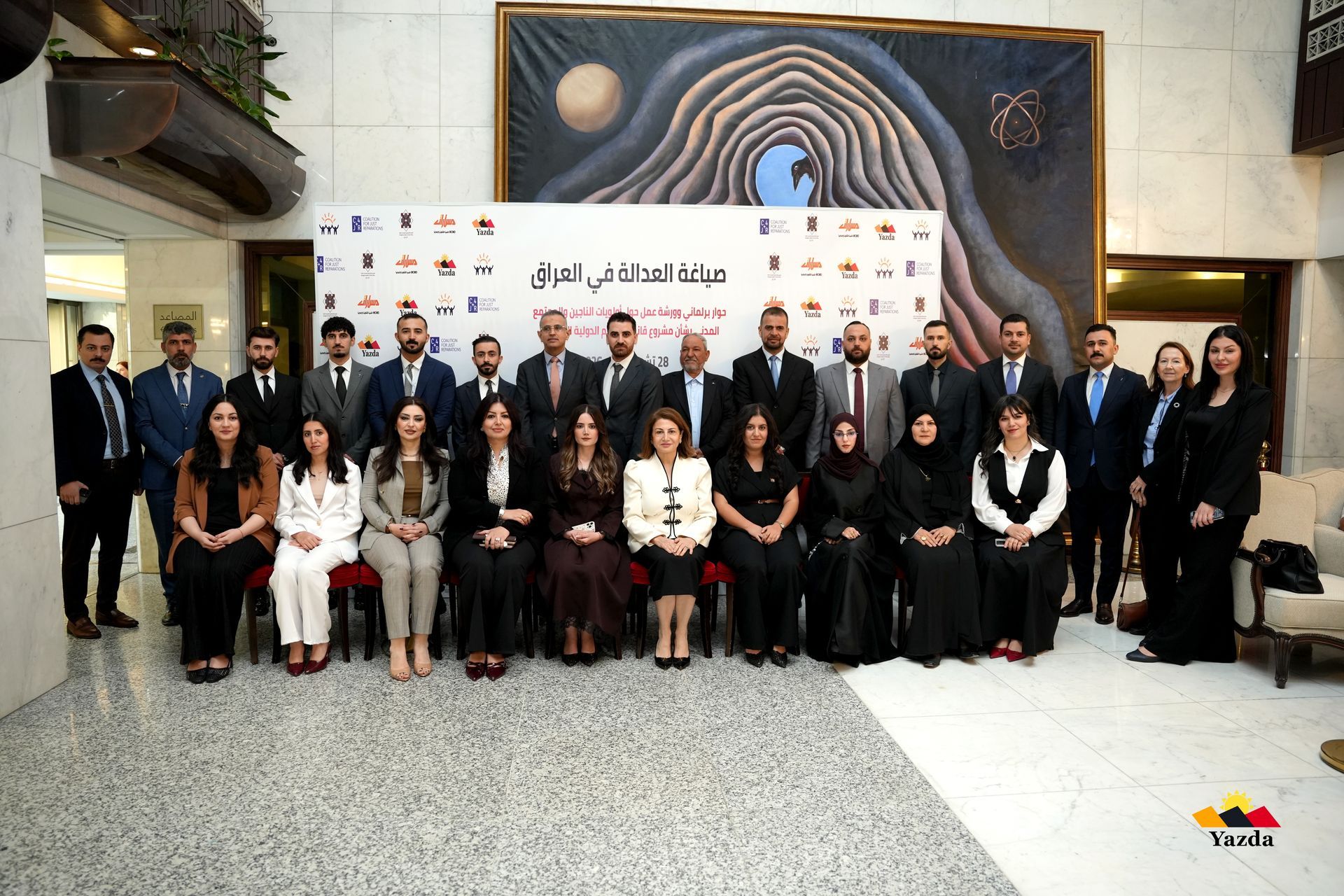
Baghdad, 28 October 2026 – Today, Yazda, with the support of the Survivors Rise Network (SRN), the Coalition for Just Reparations (C4JR), Masarat Foundation and the Strategic Foundation for Public Policy, held a Parliamentary Dialogue and Workshop in Baghdad on Iraq’s draft Law on Core International Crimes. The law would give Iraqi courts a legal basis to prosecute genocide, crimes against humanity and war crimes.
The dialogue brought survivor advocates, civil society organisations and legal experts into direct discussion with Iraqi Members of Parliament, alongside representatives of the judiciary, the government, diplomatic missions and UN entities. Opening speakers included: a representative of the Survivors Rise Network (SRN), a representative of the Speicher families, Dr. Bahaa Al Araji, Member of Parliament; Mr. Naser Omran, representing Judge Dr. Faiq Zedan, the President of the Supreme Judicial Council; Ms. Alaa Talabani, Advisor to the Prime Minister on Women’s Affairs; Mr. Murad Ismael, Member of Parliament and Head of the Yazidi Cause Alliance Bloc and Mr. Zeeshan Amin, Head of UNOCT in Iraq.
More than twelve years after ISIL’s crimes against Yazidis, Christians, Turkmen, Shabak, Kaka’i, Shi’a Muslims and other communities, perpetrators in Iraq have mainly been prosecuted under counter-terrorism law, for membership of a terrorist organisation rather than for the crimes they committed. Meanwhile, ISIL members are being tried for genocide and crimes against humanity in countries including Germany, France, Sweden, the Netherlands and Belgium. The draft law, approved by the Council of Ministers on 24 August 2026 and read for the first time by the Council of Representatives on 21 September 2026, offers Iraq the opportunity to close this gap.
The dialogue also marked the launch in Baghdad of the Survivors Rise Network, a survivor-led network bringing together advocates from Yazidi, Christian and Shabak communities and open to survivors from all affected communities. Following its launch in Erbil last week, network members presented their policy brief, Survivors’ Priorities for Iraq’s International Crimes Law, setting out five changes they ask Parliament to support:
- meaningful participation of survivors in proceedings;
- specialised protection and support, so that seeking justice does not cause further harm;
- reparations that are real and enforceable;
- specialised and representative institutions;
- mandatory coordination between institutions, with safeguards for confidential information.
Civil society organisations and legal experts then presented proposed amendments drawn from C4JR’s legal commentary on the draft, covering the definitions of the crimes, jurisdiction over past and future crimes, evidence, sentencing and international judicial cooperation. In the afternoon, MPs, survivors, civil society and experts discussed priority amendments, and agreed on follow-up steps to keep survivors and civil society involved throughout the legislative process.
The dialogue was closed by Thikran Mato, human rights advocate, consultant of the Survivors Rise Network and Director of Nobody’s Listening, who called on decision-makers not only to listen to survivors, but to work with them as partners: “Justice that concerns us must not be shaped without us.”
Since 2014, Yazda has advocated for justice and accountability for ISIL’s crimes in Iraq. Within C4JR, Yazda led the development of the 2022 Position Paper on an ISIL Accountability Mechanism in Iraq, informed by survivors’ views. Building on this work, Yazda initiated a review of the current draft law with the support of Justice Rapid Response (JRR) and in consultation with C4JR members and survivors. Today’s dialogue also built on the stakeholder consultation co-organised by Yazda and C4JR in Erbil on 17 September 2026.
Natia Navrouzov, Executive Director of Yazda, said:
“Justice for these crimes should have started in Iraq, where they were committed. But it is not too late, and Iraq can still take a leading role. Survivors welcome this draft law and want it to succeed. They are not asking Parliament to change its purpose, but to help make it stronger. Survivors are not only witnesses or beneficiaries. They know what justice means to them and what they need to take part safely, and that makes them advisors. We hope today is the first of many meetings between Parliament, survivors and civil society, until the law is adopted.
###
Download this Press Release here.
Read this Press Release in Arabic here.
For media inquiries, please contact:
info@yazda.org
About Yazda:
Yazda is a non-governmental, non-profit organization that was established in 2014 in response to the genocide committed by the self-declared Islamic State (ISIS) against the Yazidis and other minorities in Iraq. Yazda manages a portfolio of humanitarian, justice, advocacy, and development-related projects, all of which are community and survivor-centered in terms of design and implementation. Since its inception, Yazda has been working with local and international partners to provide humanitarian, accountability, and advocacy services to vulnerable minority groups in Iraq in their post-genocide recovery. The organization has been operating in Iraq since October 2014 and has main offices in Duhok in the Kurdistan Region of Iraq and a branch office in Sinjar in Nineveh Province. Yazda is registered as a non-profit organization in the United States, the United Kingdom, Iraq, Kurdistan Region of Iraq. Since its creation, Yazda has received support from numerous donors, both institutional and individual, and has reached tens of thousands of direct and indirect beneficiaries through its programs and initiatives.
About the Survivors Rise Network (SRN):
The Survivors Rise Network (SRN) is an inclusive, survivor-led platform that brings together trained survivor advocates from different communities to strengthen collective advocacy, promote collaboration and meaningful survivor participation, and engage with institutions and partners to advance the rights of survivors of ISIL atrocities. By working collectively, the Network seeks to strengthen survivor leadership and contribute to more inclusive and survivor-centred policies and decision-making processes. Guided by the principles of survivor leadership, inclusion, dignity, respect, a survivor-centred approach, and Do No Harm, the Network advocates for truth, justice, reparations, accountability, and guarantees of non-repetition.